- Sitemap
-
Inquiry


- Japanese Japanese
close
Inquiry
close


As a dedicated shipowner, we own a fleet centered on large crude tankers and supply them to operators with crew members, taking charge of all ship operation and management.
As an integral part of the energy supply chain, we proudly contribute to Japan's stable energy supply and the continuous growth of the maritime industry.
The shipping industry operates on a division of labor between shipowners, who are responsible for owning and maintaining vessels, and operators, who handle vessel operations and cargo collection.
While major shipping companies operate as both shipowners and operators, our company has been developing its business exclusively as a pure-play shipowner for nearly 90 years since our establishment in 1937.
On the other hand, there are also many ship management companies that do not own vessels themselves but contract a part of the shipowner's functions (ship management operations), such as crew manning, repairs, and management.
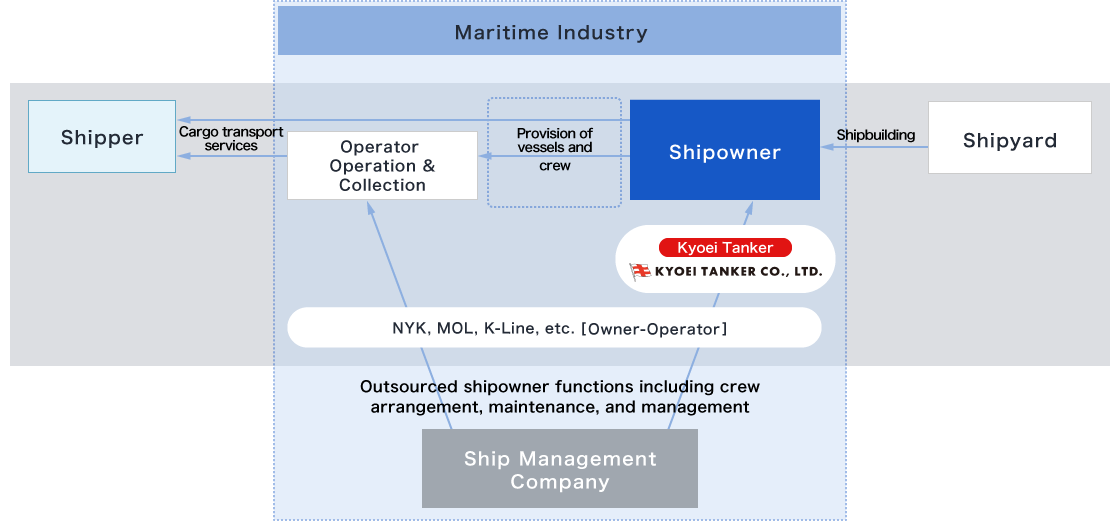
| Shipowner | Shipowning, Manning, Repairs, Management 【Provision and maintenance of shipping services】 |
|---|---|
| Operator | Booking of cargo from shippers, Voyage planning, Cargo collection 【Transportation services for shippers】 |
For us as a shipowner, our connections with related industries are also a crucial aspect of our business.
Through close frequent information exchange with shipbuilding companies, we have built a cooperative relationship aimed at improving the technology and performance of vessels. When building a vessel, we work closely with them from the design and construction stages, aiming to maintain the good condition of our vessels over the long term and to provide safe, high-quality transportation utilizing those vessels.
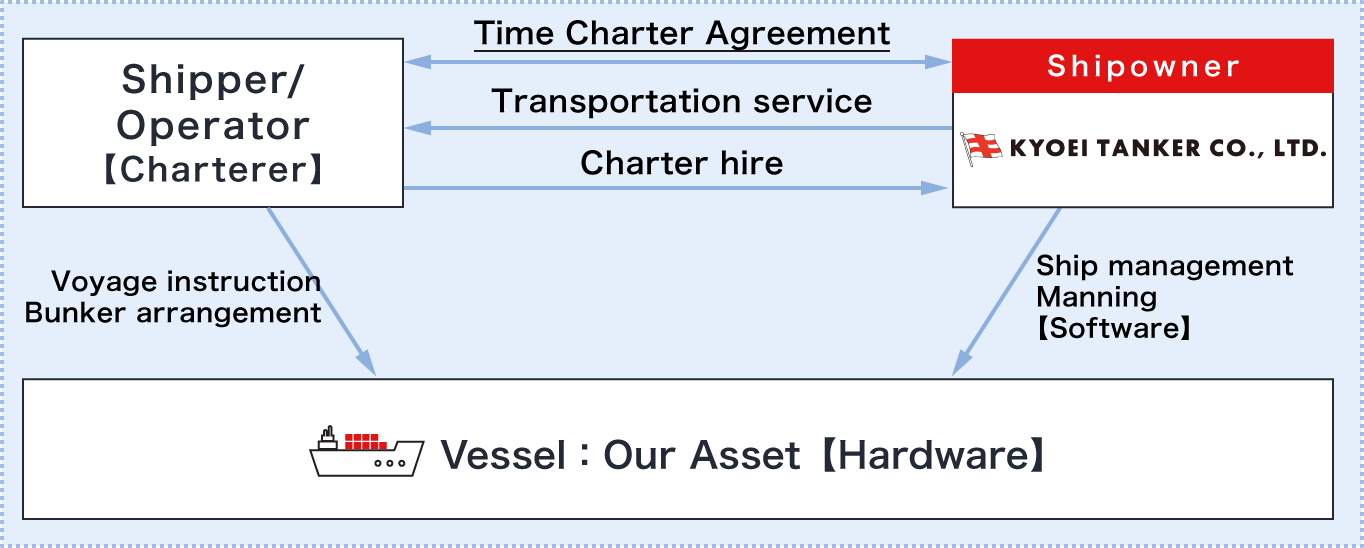
[Time Charter Agreement]
An agreement in which a shipowner provides a charterer with transportation services using a transport-capable vessel manned by a captain and crew for a specified period, and in return, the charterer pays charter hire based on that period.
[= Transportation (Service) Contract]
We enter into time charter agreements with our customers and provide our owned vessels as a transportation service.
(Customers under this contractual relationship are referred to as "Charterers.")
Our company (the shipowner) provides the vessel in an operational condition throughout the contract period (transportation service) and, in return, receives the charter hire specified in the contract from the customer (the charterer).
The roles and cost allocation of the parties related to vessel operations under a time charter agreement are as shown in the table below.
| Item | Shipowner | Charterer |
|---|---|---|
| Provision of Master & Crew | 〇 | |
| Vessel Maintenance & Management | 〇 | |
| Employment Instructions | 〇 | |
| Cost Allocation | Operating Expenses Maintenance costs, crew expenses, etc. |
Voyage Expenses Bunker costs, port charges, etc. |
Since our establishment in 1937, we have been engaged in energy transportation as a shipowner for nearly 90 years. As an "Expert in Seaborne Energy Transportation," leveraging our outstanding ship management technology as a core strength, we have fulfilled our function as a piece of infrastructure playing a vital role in Japan's energy transportation.
Our annual crude oil transportation volume is equivalent to approximately a month of Japan's crude oil consumption, contributing to the energy security of our country, which relies on imports for almost 100% of its domestically consumed crude oil.
Currently, we not only transport crude oil through our Very Large Crude Carrier (VLCC) business, but also excel in transporting other energy sources such as LPG and petroleum products, proactively expanding into these areas.
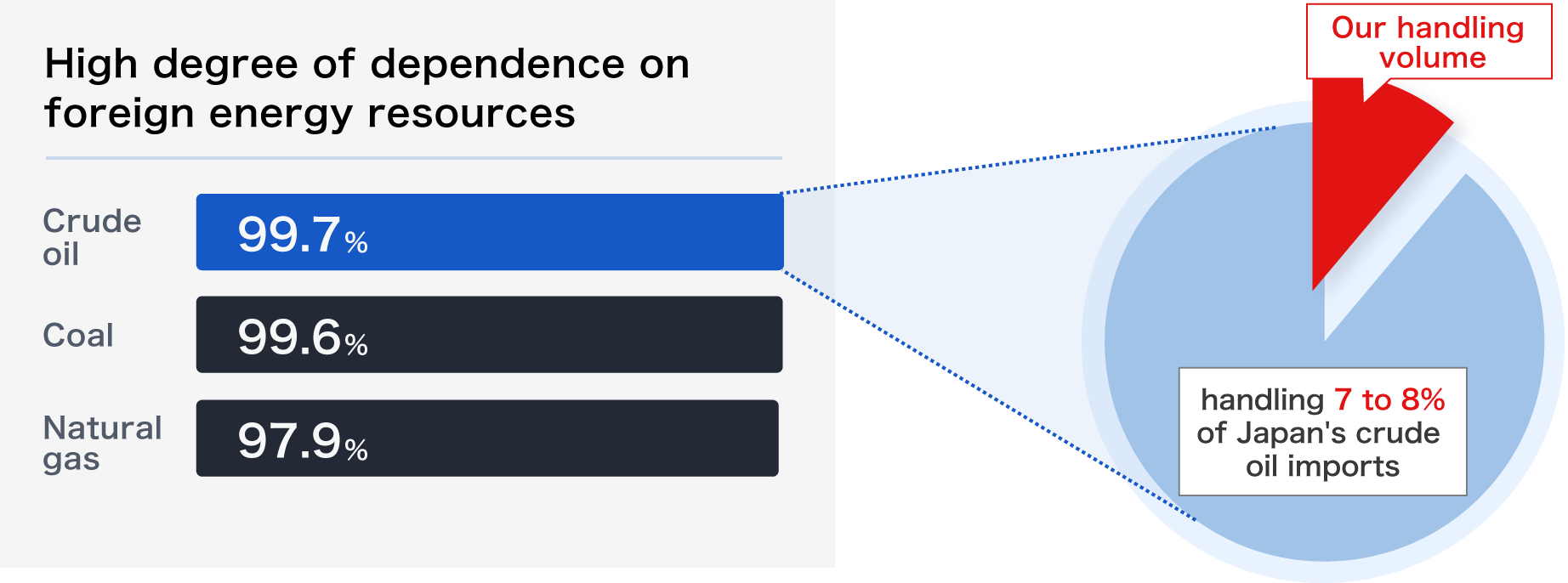
*Graph source: 'SHIPPING NOW 2025-2026'
Such seaborne energy transportation requires advanced ship management technology.
Backed by highly skilled crew members working as a group of energy transportation professionals, our ship management technology is our strength and an essential business foundation that brings high added value to our business and differentiates us from our competitors.
As mentioned earlier, many major shipping companies operate as both shipowners and operators.
In contrast, we have focused on the energy transportation sector with a strategy of narrowing our focus exclusively to shipowning, without pursuing operations like cargo collection. This allows us to utilize our limited management resources effectively and strengthen our business. Under this strategy, we have intensively refined our knowledge related to energy transportation and our ship management and operational technologies, demonstrating a unique business model and a firm presence in the shipping industry as what could be called Japan's only pure-play shipowner owning and managing VLCCs.
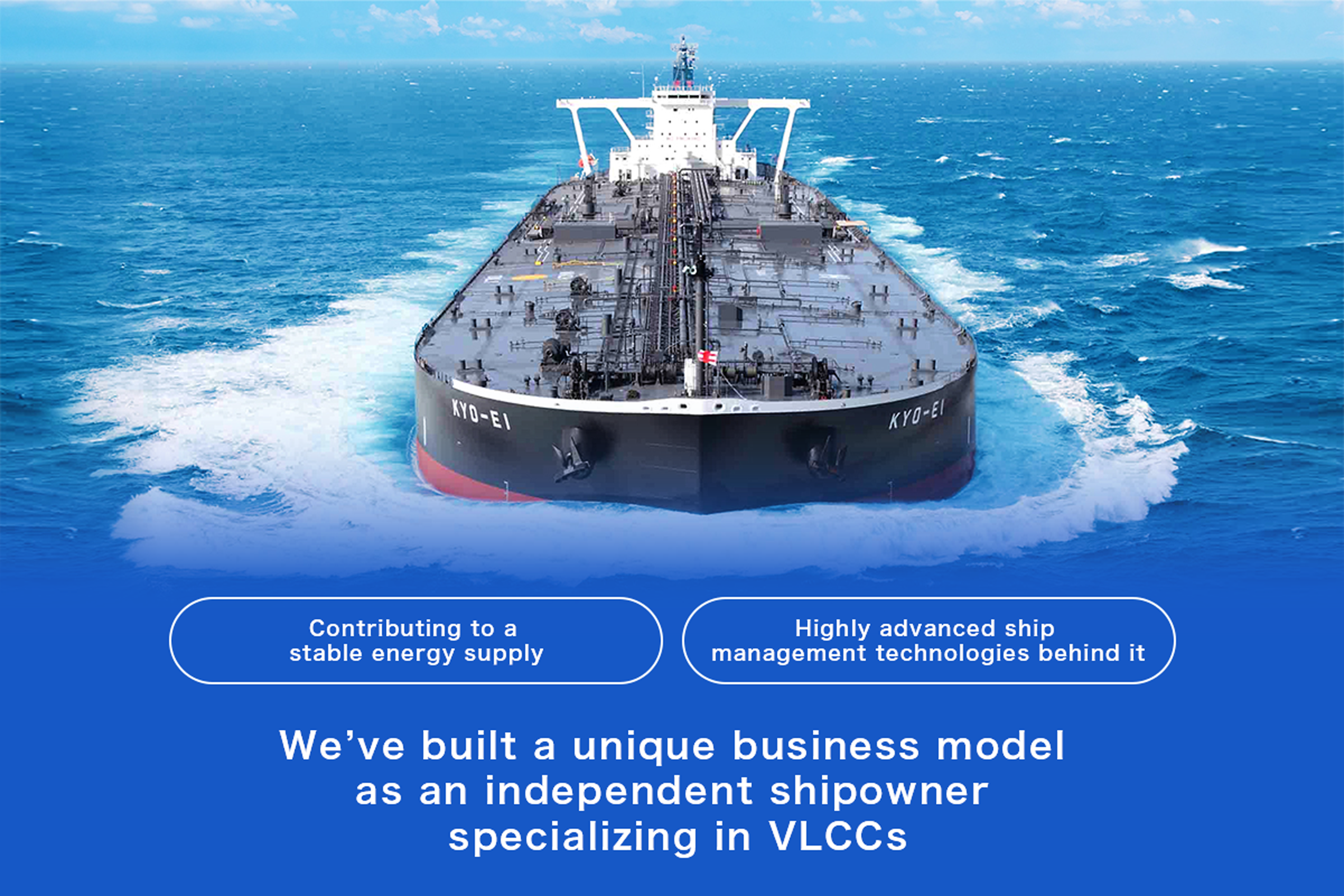
We currently own 14 vessels and meet the transportation needs of various cargoes through time charter agreements with our customers. (As of the end of March 2026)
The crude oil tanker business is our core business, accounting for the majority of our sales, and is the most important area in our management as both a stable source of revenue through long-term contracts and our technological foundation (details below).
We are also proactively engaged in vessel types other than crude oil tankers.
Among them, LPG carriers currently account for about 30% of our sales. We consider this a field where we can develop high added value while leveraging our ship management capabilities, and we plan to focus on it even more in the future.
Under this business strategy, we have currently placed newbuilding orders for 1 VLCC and 2 LPG carriers, and we will proceed with expanding our revenue base through the optimization of our fleet portfolio.
| Vessels In-service On order |
Total DW In-service On order |
|
|---|---|---|
| Crude Carrier | 6 | 1,875,948MT |
| 1 | 310,000MT | |
| LPG Carrier | 5 | 146,798MT |
| 2 | 12,350MT | |
| Bulker / Product | 3 | 215,333MT |
Next, we will explain our core crude oil tanker business.
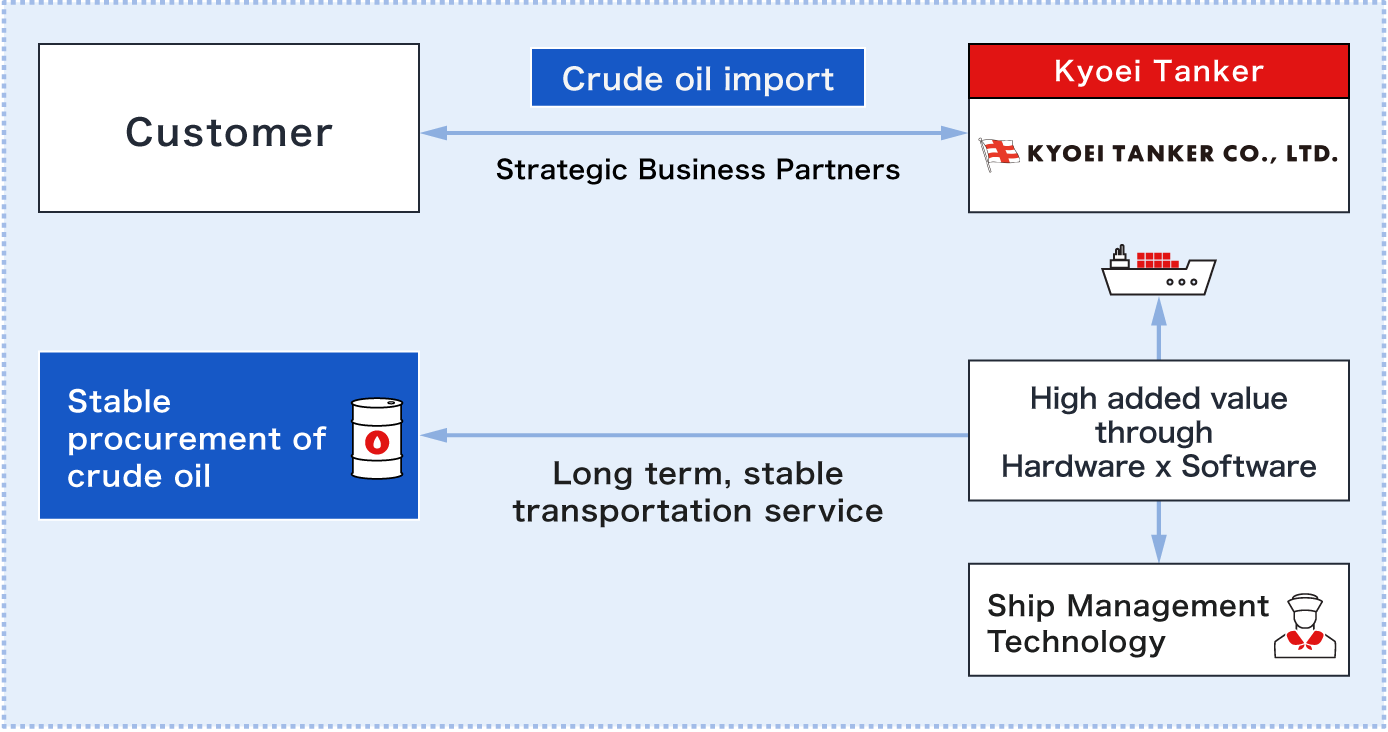
In our core crude oil tanker business, we are engaged in the common goal of the long-term stable supply of crude oil as a strategic business partner to our customer oil companies.
To steadily fulfill this responsibility, we enter into long-term contracts with our customers. This allows both parties to steadily execute transportation plans under an income and expenditure structure that is less affected by market conditions or environmental changes and is highly predictable.
Furthermore, since the construction of a large crude oil tanker requires a massive amount of funds, we closely collaborate with our customers to share future demand prospects, etc., making well-planned business investments from a long-term perspective.
Considering the magnitude of environmental pollution and economic loss in the unlikely event of an accident, the ship management of crude oil tankers requires higher safety standards and more specialized maintenance than other vessel types.
Our technological capabilities, backed by the expertise of highly skilled crew members, ensure world-class safety standards, realize efficient operations in line with charterer needs, and contribute to maintaining the asset value of our vessels.
In this way, our ship management technology serves as a valuable management resource - a "soft power" that enhances the added value of vessels - "hardware".
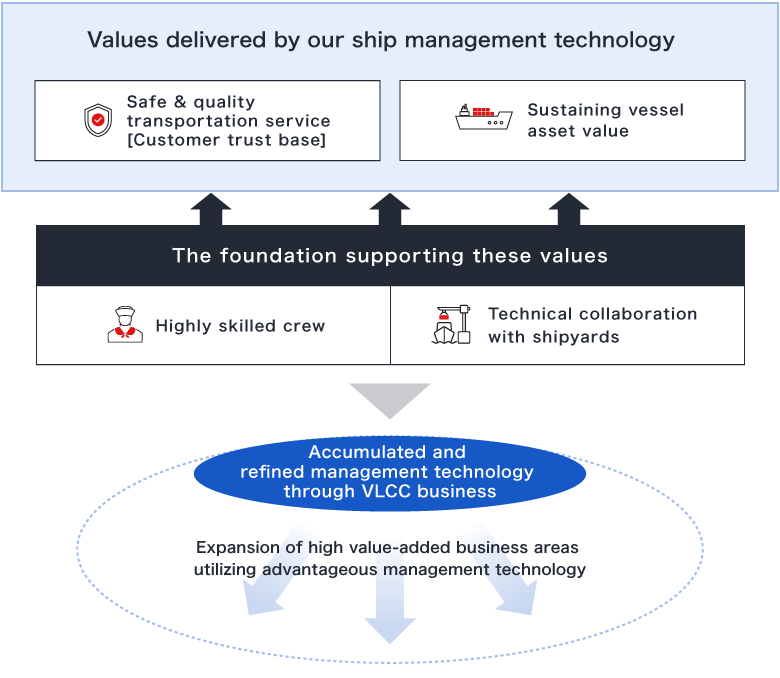
Our ship management technology has been accumulated and refined through our efforts in the crude oil tanker business, which demands high management capabilities.
As mentioned earlier, safe and high-quality transportation services form the foundation of trust with our customers, and the demonstration of this technological capability is not limited to while the vessel is in operation. Management technology and know-how accumulated through vessel operations are fed back through technical collaboration with shipyards and utilized from the construction stage. Such efforts lead to high added value for our owned assets in the form of supplying high-quality vessels.
Regarding the highly skilled human resources that support this, we are systematically and continuously advancing their recruitment and training, addressing the succession of high-level skills from a long-term perspective.
We will further advance the creation of a system that allows us to utilize these advantageous management resources more broadly, and we will actively engage in efforts to add high value in other businesses, including LPG carriers, to expand our high value-added areas.
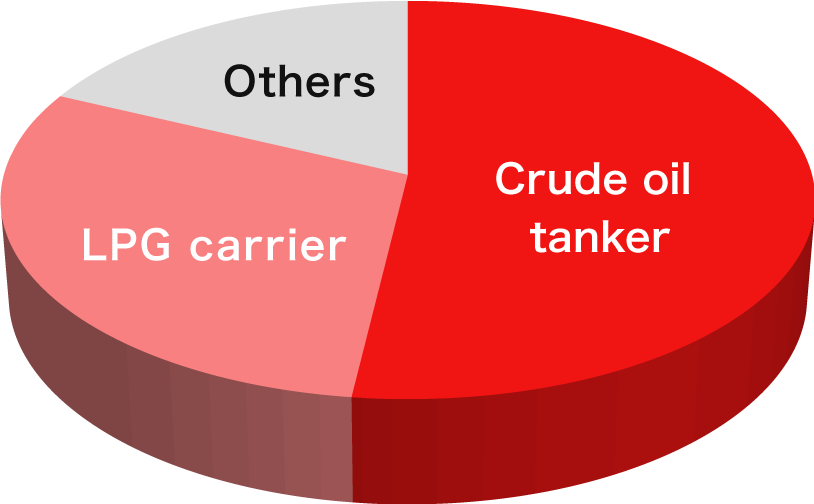
Regarding the sales ratio by business, crude oil tankers account for the majority, followed by the LPG carrier business at about 30%, with bulkers, product carriers, etc., making up about 20%.
Our business revenue consists of charter business revenue, stably obtained based on contracts, and gains on the sale of vessels after the end of the contracts.
Mid-to-long-term time charter agreements make up a large proportion of our business, centered on our core crude oil tanker operations.
Because of this, many of our vessels earn stable charter hire income that is not easily affected by market conditions.
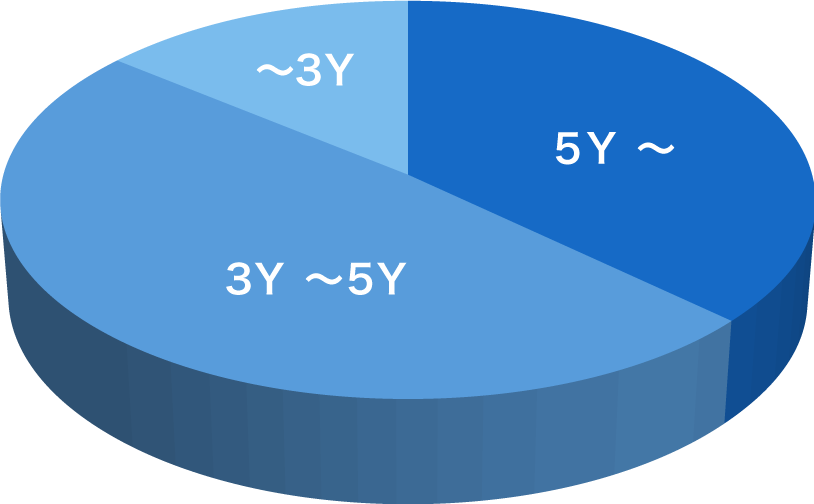
Furthermore, for us as a shipowning company, the sale of vessels is also a significant business revenue opportunity. By maintaining the asset value of our vessels through appropriate maintenance during the holding period, we aim to maximize our final return on investment through well-timed sales.
Charter business revenues are generally recorded as operating profit, and revenues from the sale of vessels are recorded as extraordinary profit, trending as follows.
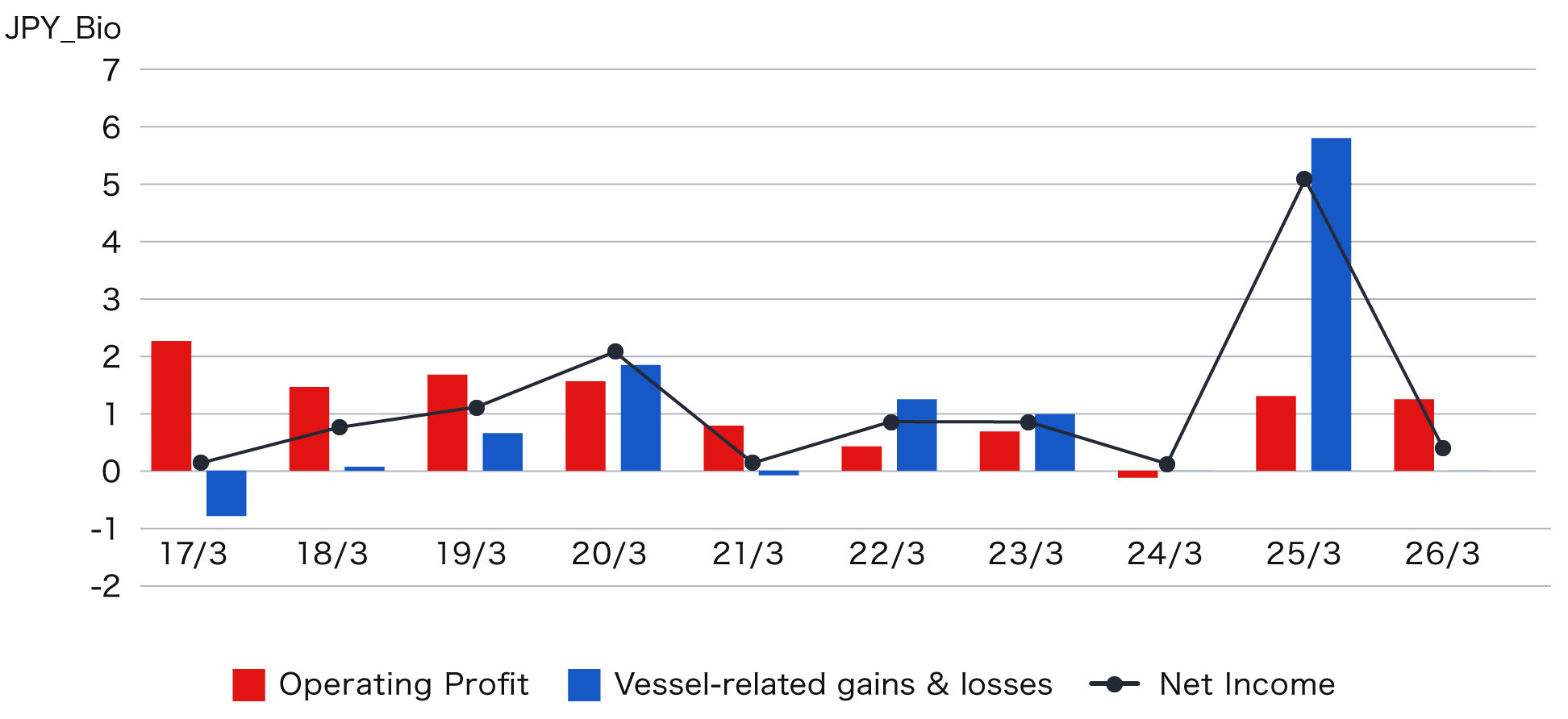
Vessel-related gains & losses : Net gain/loss on disposal of vessels, impairment loss, etc.
The crude oil tanker business will continue to be our core business as a stable source of revenue and technological foundation, and we will systematically advance investments under demand forecasts from a long-term perspective.
We will also proactively engage in businesses other than crude oil tankers.
Among them, we recognize LPG carriers as a field where we could deploy high added value utilizing our ship management capabilities, and we plan to focus on this even more.
In this business, we intend to work with vessels on shorter contract periods in the future to capture charter income that benefits from favorable market conditions. We will proceed while carefully assessing the risk-return commensurate with our financial strength, focusing mainly on small and medium-sized LPG carriers.